CONVERSATIONS WHILE WAITING FOR GEORGE
By Mark Neuling
Videographer for TechTV
Wednesday April 30th, 2003
It’s late into my shift when the Future’s Producer calls me at
my desk. Certain producers here have a tone in their voice akin to
that of a Tele-marketer. They sound like they’re trying to sell
you on something that you don’t really need. “Did the assignment
desk fill you in on Friday’s shoot?” he inquires. “Not
yet,” I say. “How’d you like to cover the President?” he
asks. “The president of what?” I snort. “Bush
is flying into Moffett Field on Friday morning and we want you to be
there,” he
tells me. “What is there that CNN or one of the locals can’t
get that we would need?” I ask. “Interviews,” he
replies. Interviews I wonder, who would we possibly get interviews
with?
I’m not given specific details; the producer says
he’ll call me with them before I leave. I give him my date of birth
and social security number for the background check. I’m taking Thursday
off because my wife is having a breast-biopsy and she needs me more
than work does. The producer never does call back.
Friday
May 2nd, 2003
The weather forecast for today calls for an inch of rain. Rain this
time of year is rare in the Bay Area. The record for this date is only
a quarter of an inch; we could get drenched at Moffett. I’ve
got all my rain gear and the reporter has his umbrella.
We leave for the President’s visit around six forty-five in the morning. I’d
gotten conflicting information the day before from the producer and the reporter. Press
credentials would be issued between seven and nine one told me. We
had to be in place by eight the other says. I’d rather get there
early and wait around than have to scramble for a camera position. California
is not “Bush Country.” Since this is only President Bush’s
sixth official visit to California it will be well covered by the press.
Traffic is light, the drive will take us about 45 minutes. The plan
has changed. We will not shoot Air Force One at Moffett. We’ll
drive to United Defense in Santa Clara and tape the President’s speech
there, then we’ll make the 10-minute drive north and shoot a stand-up
as the President’s plane departs. That’s our scenario for
now.
The reporter fronting this story is a dozen years younger than I
am, but he actually covered Ronald Reagan late in his presidency. As for
me this is a first. I’ve covered practically everything after
19 years in television but not the president. On the drive down we
discuss the shoot. Being a niche broadcaster we need a tech angle to
our story. We are having a hard time finding one. In a nutshell
we’re making this up as we go; we’re doing this because we can.
United Defense manufactures the Bradley Infantry Fighting Vehicle
that played such a prominent role during the war in Iraq. Part of the reason
for the President’s Santa Clara visit is to thank the workers at United
Defense for their contribution to the war effort. He is scheduled to
land at 9 AM, have a brief tour of the facility and make a speech to the
employees. Take-off in Air Force One is scheduled for 10:50 later
that morning. This is to be a whirlwind tour to say the least.
The
police and Secret Service are polite but very business-like. As
we park the car at least five or six news trucks are already in place
with their microwave antennas pointing skyward.
We
find the tent were the press credentials are issued.
There is no line. The
reporter I’m shooting for comments on the quality of the
press credential, “Gee I know there’s a recession
on,” he
says “but these aren’t even laminated. We could
have gone to Kinko’s and made these.” Never the less
it ’s
a pretty cool souvenir for my scrapbook. |
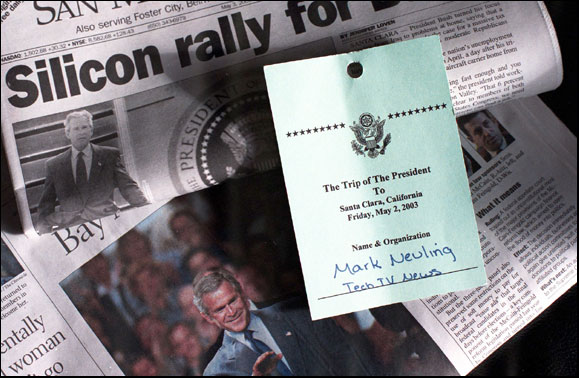
The press credential issued to members of the press for
President George W. Bush's visit to Santa Clara, California.
May 2, 2003
© Mark Neuling 2003
|
|
Next
we move to the queue for the metal detectors. A stocky middle-aged
man in a white shirt and tie with his television camera and tripod
neatly packed in their carrying cases gets in line behind us. Not your
typical looking TV news shooter. He’s very chatty and strikes
up a conversation with us. Turns out that he is a junior college student. He
spent 25 years in the tech industry and got laid off. After a year
of searching for work he decided to switch careers and went back
to school to study broadcast journalism. He jokes about maybe needing
help setting up his tripod. This is a first for him too.
We are ordered to place all photography gear and bags in a line
on the ground. We will have to pass through the metal detectors and then
come back for our equipment. A few photographers joke about getting “new
gear” while the rest of us wait to clear security. Some grumble
about the possibility of the equipment getting soaked in a downpour. The
junior college student worries where his gear may have been since various
people from his school use it. He’s assured the dog isn’t
sniffing for any “illegal substances.” They bring the dog
over to smell the cameras.
On the second pass-by the dog’s snout gets a little too familiar with
one of the TV cameras, it tips over onto it’s viewfinder, a reporter
gasps. I grit my teeth because it was my camera the pound puppy upended. A
mutt with an over-active olfactory gland takes out a seventeen thousand-dollar
camera and there’s no concern from either the dog’s handler or
the Secret Service. My tax dollars at work.
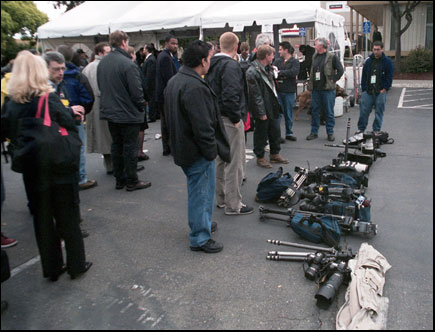
Member of
the press wait for their camera equipment to be cleared by
security.
© Mark Neuling 2003 |
|
As
we wait to pass through security one of the reporters wonders out
loud, “What happens if the dog pee’s on something?” “Oh
then you’re in big trouble,” her photographer tells
her straight-faced.
The
reporter I’m teamed with clears the metal detectors first and
takes my tripod inside. I pass through without incident and
check over my camera. Everything seems to work; I grab
the rest of my gear and head in.
|
The
event is taking place in a machine shop the size of an airplane hanger. Picture
an old high school metal shop but big enough to hold two thousand people. On
the right side of the stage is a Bradley. A
huge American flag provides the backdrop. At the center of the
stage is a small podium with the Presidential Seal. The back of
the auditorium has three tiers for cameras. The reporter
working with me has set up my tripod dead center on the second
tier. The
junior college shooter has his tripod set up right next to mine. End
to end the top two levels is a jungle of television tripods; with
radio reporters and a
handful of still shooters sprinkled throughout. Television
seems to be the media with muscle here.
The reporter I’m with wants to shoot a stand-up in case we don’t
get one at Moffett Field. Good idea I think. He asks me
to tilt down from the distant stage to him standing on the near empty concrete
floor. To me it looks real ugly and I’m not happy with it.
People slowly file in. The CEO of United Defense makes a short
speech. At
the conclusion of the speech the lights dim and a voice-over with
martial music underneath serenades the audience. The video screen
hanging above the stage remains blank. One of the newspaper photographers
quips how he loves it when the video fouls up, or language to that
effect. Someone
eventually gets the video going and we are treated to pictures
of Bradley Fighting Vehicles crossing the desert, backlighted by
the setting sun. Finally
the presentation ends with the statue of Saddam Hussein being toppled
in Baghdad. The crowd applauds and then we wait, and wait.
The correspondent I’m with is an excellent reporter. He has a
way of taking pedestrian stories and making them informative and interesting. But
we have an unusual method of shooting stand-ups. He suggests one way
and I recommend another, then we do both. Guess whose version usually
airs? I convince him to re-do his standup. This time he’s on
the platform in front of me. The American flag and a Bradley A3 fill
the frame behind him; it’s a far more effective shot.
Guests are still making their way into the auditorium. The media pool
must look quite impressive to the audience. Many people are taking
pictures of us taking pictures of them. The same loop of patriotic
music plays over and over. I wonder if John Philip Sousa is still
getting royalty checks?
On the tier behind me is a reporter from a Los Angeles station. He
had freelanced in San Jose about 15 years ago; we covered the Loma Prieta
Earthquake together. He’s a hard-core, old-time news hound. We
catch up on who has retired, who has been fired and who is working where. It’s
a revolving conversation between two or three videographers and the L.A.
reporter. The junior college guy has his camera on the shoulder and
seems to be taping our conversation. Everyone seems to have a
connection to one another. We’ve worked with some of the same
people at different times and at different places. It’s a
small fraternity.
The reporter from Los Angeles asks about ratings between the various
Bay Area stations and what morale is like. He laments how the industry
has changed. Weakened unions, youngsters who’ll work long hours
for low pay. Everything is rushed now, no time for research or writing,
certainly no time for visuals. The photographer next to me agrees. He’s
been with his station for 28 years. He has to shoot, edit and run his
own live-truck. One person does three jobs. I’m lucky;
I just have to shoot.
The conversation turns to home and how important it is to not let
work interfere too much with family-life. I wonder what would happen
to our daughter if my wife were seriously ill.
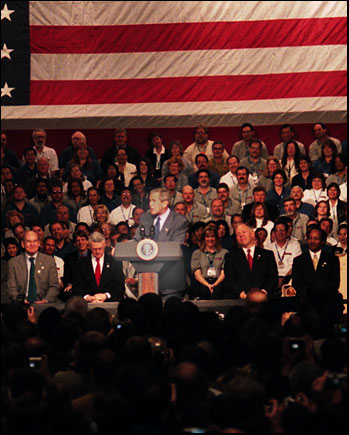
President George W. Bush speaks to employees at United Defense
in
Santa Clara, California. May 2, 2003.
© Mark Neuling 2003
|
|
About
then executives from United Defense walk across the stage
to their seats, the public address system announces the President
of the United
States; Hail to the Chief swells throughout the auditorium. George
Bush walks on to the stage amidst cheers. I can feel my heart
pounding. The red light in my viewfinder is on, the audio
levels are clean and strong, I am videotaping one of the most powerful
presidents
the world has seen since Harry Truman.
The President
thanks the workers of United Defense for the role their systems
played during the war in Iraq and in the fight against terrorism. The
speech has a very familiar ring to it; I've heard portions of
it for months in sound bites from the news. He seems confident
without being cocky, polished, but rehearsed. The man has
a good sense of humor and the timing of a talk show host. The
speech moves to tax cuts and the effect they will have on the
economy and for business. But at several junctions he stumbles,
he seems to have wandered from the script, the VU meters in my
camera drop during these passages. It’s as if the
electronics in the camera sense something. I no longer notice
my heartbeat. It’s become another shoot. |
After
forty minutes the President wraps up his speech, we have to shoot the
stand-up again for the third time. We finally
have an angle to our story; can an increase in Defense spending
help to revive the slumping
economy of Silicon Valley? We are going to make a quick stop on
the way back to the city at a small company in Sunnyvale that use
to make components
for cell phones. Their technology is now being used in radar devices
for Apache helicopters. We’ll shoot a quick interview with
the CFO and get some B-roll. As I break down we ask the junior
college student what he learned? He shrugs, “To bring fresh
batteries and longer tapes.” Knowledge that I’m sure
will come in handy for him some day.
It’s almost 1 PM before we leave the second shoot. I have
a headache; I haven’t eaten anything since breakfast around five
that morning. I
haven’t used the bathroom since I got to work around six-thirty. Such
is the life of a newspuke. It’s starting to rain and we have
40-mile drive back to San Francisco. Air Force One is long gone
as we pass Moffett Field on the drive north.
When I get back to my desk I see that there is a voice-mail for
me. Nine
times out of ten it’s from my wife. Could she have gotten the
results back from the biopsy already, they weren’t due until Monday
afternoon? I eat lunch with another of our videographers, a woman. Most
of our lunchtime conversation is about my wife and what might loom ahead
for us. The rain only dampens our mood as we head back to the office.
The voice-mail is from my wife and she has gotten the results from
the biopsy. I can tell from the buoyant expression in he voice that
the news is good. She shows no signs of cancer. It’s
been a long day of firsts.
Mark
Neuling
The opinions expressed are solely those of the author.
Email info: markneuling@techtvcorp.com
TechTV is the world’s leading cable and satellite television channel
covering technology news, information, and entertainment from a consumer,
industry, and market perspective 24 hours a day. Available in more
than 75 million households across 70 countries, TechTV is also the world’s
largest producer and distributor of programming about technology.
Copyright TechTV 2003 TechTV Inc. All rights reserved.
|